|
Elbow, Meet Knee
A concept that transcends technique and dictates how many of them are used.
|
|
This blog post starts out as a newsletter. To read this kind of content early, click here to subscribe and you will get it to your inbox for free!
|
|
Hey there,
If you've been subscribed to this newsletter for some time, you've noticed that it can be a little sporadic. The idea is to get one out each month, but sometimes that doesn't happen. One of the biggest obstacles to that is how labor intensive it is to not just write about jiu-jitsu, but to also shoot pictures, edit them, sort them, lay them out, put them in a newsletter software etc. This is how I set out to design this newsletter.
However, it occurred to me recently that it's my newsletter and that I quite literally make the rules. At a higher level, the goal of this is not to deliver techniques with pictures to your inbox once a month—it is to:
|
|
1. Deliver content that has a solid chance of making your jiu-jitsu better
2. Having an email that you get excited to see, click on and read
|
|
|
Recently I have been thinking, teaching and writing about concepts a lot more than techniques, so in this edition we will look at a concept that transcends technique and dictates how many of them are used.
Let's jump into the concept of elbow to knee connection.
|
|
Note: None of this newsletter is ever AI written. I would sooner commit harikiri. Just pointing that out because there are em dashes in the text, which are both good grammar and a way to spot AI slop. This is purely human and hopefully not slop!
|
|
|
Elbow-Knee Connection

Elbow-knee connection is one of the most fundamental defensive concepts in jiu-jitsu. At its core, it's about protecting your torso and your limbs, at the same time.
When your elbows and knees stay connected, or at least close enough to reconnect quickly, you create a structural shield that makes it difficult for your opponent to expose your back, pass your guard, or dominate your upper body.
The tighter that space, the less room there is for your opponent to insert hooks, pass frames, or isolate limbs. Once that connection is broken, the doors to your core—and the path to control—open wide.
Keeping elbow-knee connection doesn't mean being static; it means moving in a way that maintains your structure under pressure, like when framing, shrimping, turtling, or recovering from a guard pass.
It also doesn't mean precisely aligning the tip of your elbow with your patella. Elbow-thigh, or elbow hip/rib connections can work just as well, depending on the situation.
|
|
Elbow-Knee from Guard

When we're under pressure from a guard passer, our forearms and shins become four essential frames. Each can function well on its own, but they're far more effective when used together. By connecting the elbow and knee, we create a "super frame"—a defensive structure that can prevent guard passes or help us recover guard, like during a hip escape from side control.
A lot of the best guard players are indeed very flexible, but what their flexibility allows them to do is keep their knees and elbows even closer than most—both in seated and supine positions. For those of us that lack that freakish flexibility, the concept still applies and we need to curl into a ball as much as possible to prevent certain passing approaches.
Even in closed guard, we use our legs and torso to break the opponent's posture—which naturally brings our knees closer to our elbows. In half guard, a knee shield combined with the same-side forearm creates a strong frame that's critical for defending the underhook.
From bottom position, keeping the elbow and knee close is one of the simplest ways to stay safe. For the opponent, the road towards a pin goes through stripping the frames away from your stomach. The objective is to make this impossible or at least very hard and costly in terms of energy consumption, while at the same time looking for opportunities to separate the guard passer's knees from the elbows.
From mount to half guard or single leg X, from side control to half guard or closed guard—recovery will always start with the knee coming to the chest, with the elbow coming to meet it.
|
|
Elbow-Knee When Passing

What changes when we start thinking about the elbow-to-knee connection from the top position? There's an ally—gravity. This enables us to use this concept more offensively.
However, it all starts with staying safe. While the guard player is susceptible to the effects of mass times acceleration, he can also be dangerous. Armbars, omoplatas, certain chokes, and all kinds of sweeps rely on getting control of the torso.
To take advantage of this concept for offensive purposes, we need to think about it every time we step a foot between the opponent's legs. The knee obviously follows closely behind the foot, and the elbow should not be far behind. When passing closed guard, half guard, and open guards via the headquarters position, this connection enables putting pressure on the shin and cutting through the guard.
When the guard is compromised, keeping the elbows tight to the body and close to the hips will give the best opportunity for securing pins while preventing the opponent from recovering guard.
|
|
Elbow-Knee When Defending the Back

A good way to test someone's experience is to take their back and see how they respond. If getting the hooks or the body triangle doesn't require any resistance, that indicates the opponent is probably a novice. Meanwhile, a black belt will feel almost impossible to hold in place and will fight the second hook with everything he's got.
That defense starts with getting the knee up to the chest and the elbow to the ribs—closing off the path for the hook. This forces the opponent to adjust and use techniques and tactics to stretch you out, unglue the knee from the chest, and secure the hook. While he's doing that, you can defend by moving and exploring paths to escape.
This concept also holds true in other positions with back exposure—turtle position, quad pod position (all fours), and all kinds of transitions leading to the back.
|
|
Explore the Manuals
Concepts like this one—and hundreds more—taught in full detail.
|
|
|
|
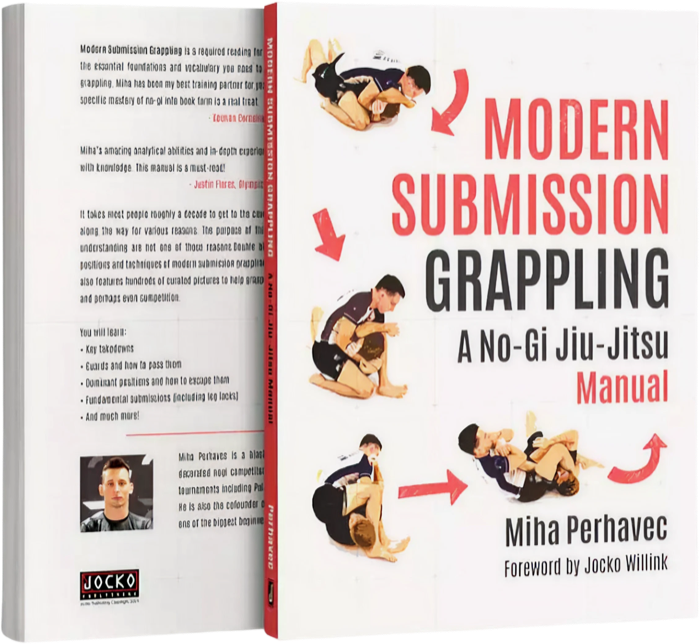
Available exclusively
on Amazon
The original No-Gi manual in paperback.
Get the book
|
|
|
|
|
© 2026 Jiu-Jitsu Manual. All rights reserved.
jiujitsumanual.com
You're receiving this because you subscribed to the Jiu-Jitsu Manual newsletter.
Unsubscribe
|
|